Spelling Rules
Below are the spelling rules that may apply when attaching an ending to a stem. These are not irregularities: they consistently apply to certain combinations of letters to preserve the correct pronunciation or follow conventional spelling patterns. Spelling rules affect only how the form is written; they never change how the form is pronounced.
Sound Preservation
The sound preservation rules ensure that the final sound of the stem is pronounced the same way before every ending.
- g → gu before e/i: When the stem ends in a hard g (as in gato) and the ending starts with e or i, insert a silent u so the g stays hard: jueg + e → juegue.
- c → qu before e/i: When the stem ends in a hard c (as in comer) and the ending starts with e or i, write qu instead of c to preserve the hard c sound: toc + e → toque.
- g → j before a/o: When the stem ends in a soft g (as in jota) and the ending does not start with e or i, replace g with j to preserve the jota sound: escog + o → escojo.
- c → z before a/o: When the stem ends in a soft c (as in zeta) and the ending does not start with e or i, replace c with z to preserve the zeta sound: venc + o → venzo.
- gu → g before a/o: When the stem ends in gu with a silent u and the ending does not start with e or i, drop the u so the g stays hard: distingu + o → distingo.
- qu → c before a/o: When the stem ends in qu and the ending does not start with e or i, write c instead of qu to preserve the hard c sound: delinqu + o → delinco.
- gu → gü before e/i: When the stem ends in gu with a pronounced u (as in -guar verbs) and the ending starts with e or i, put a dieresis on the u so that the u is pronounced and the g stays hard: averigu + e → averigüe.
Conventional Spelling
The conventional spelling rules neither change nor preserve sound—they are just Spanish spelling conventions.
- z → c before e/i: When the ends in a soft z and the ending starts with e or i, replace z with c (Spanish never writes z before e / i): cruz + e → cruce.
- i → y between vowels: When the stem ends in a vowel and the ending starts with an unstressed i before another vowel, write y instead of i: le + ió → leyó. But le + ía → leía
- ii → i and yi → y before vowel: When the stem ends in i or y and the ending starts with an unstressed i before another vowel, drop the second i because two i sounds are pronounced as a single syllable: ri + iendo → riendo.
- lli → ll and ñi → ñ before vowel: When the stem ends in ll or ñ and the ending starts with an unstressed i before another vowel, drop the i: ceñ + iendo → ceñendo.
Stress Preservation
This last rule preserves prosody, ensuring that the endings are stressed the same way with every stem.
- stressed i → í after vowel: When the stem ends in a vowel and the ending begins with a stressed i (-imos, -iste, -isteis, -ido, -ir, and -id endings only), accent the i so it remains its own syllable and does not form a diphthong with the stem vowel: ca + imos → caímos (not "caimos", which would be two syllables instead of three).
Tip: Spelling Rules vs Irregular Stems
Sometimes spelling rules look like irregular stems. Consider oír. On the one hand it has an irregular Boot stem oy-. This is not a spelling rule because the added y actually changes pronunciation: oye is pronounced "oy-E" instead of "o-E". On the other hand, although the prefix oy- also appears in all the Gerund-stem positions (oyendo, oyó, oyera, etc.), the y in these forms is not an added sound—it's just the i from the ending changed to a y by the i → y between vowels spelling rule ("oiera" → oyera); the pronunciation doesn't change.
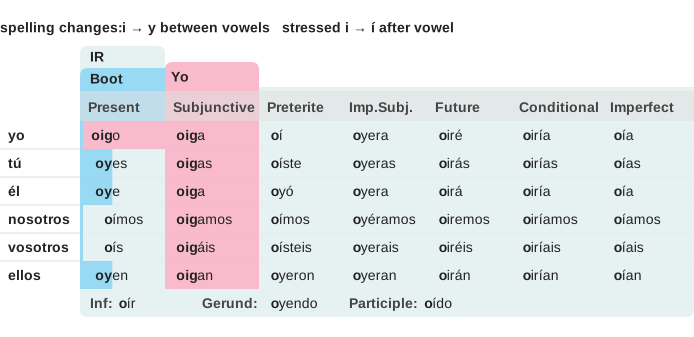
Note oír also has the stressed i → í after vowel rule ("oiste" -> oíste). That's why there is even an accent on the infinitive oír: the spelling rule preserves the consistent stem+ending pronunciation "o-IR", otherwise it would be a a monosyllable "oir".